


Finite VS infinity corrected optical systems
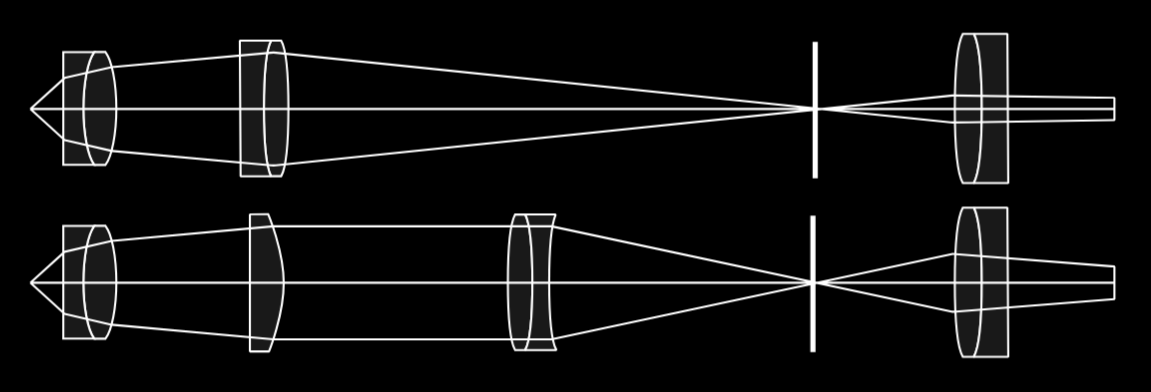
Image credits: Olympus catalog
When buying a microscope, you usually face two main choices:
- A modern infinity-corrected microscope
- A more traditional microscope with finite-conjugate optics
The first option is generally much more expensive than the second.
In this article, we analyze the advantages and trade-offs of each design.
Finite conjugate optics
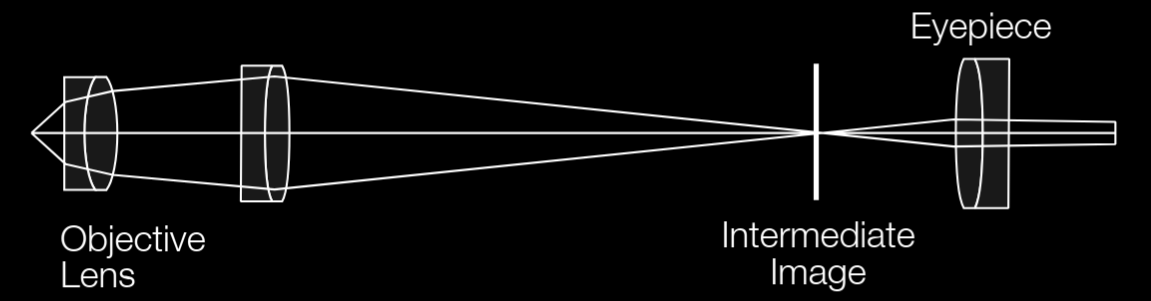
Image credits: Olympus catalog
Historically, infinity-corrected microscopes are a relatively recent development.
Most available microscopes are finite.
How to recognize a finite objective
Finite objectives are marked with a specific inscription (such as 160/0.17 or 160/-) on the barrel:
- The first value (e.g., 160) indicates the mechanical tube length in millimeters.
- 160mm is the most common tube length
- 170mm for finite Leitz Wetzlar
- Nikon M Plan are 210mm
- The second value specifies the coverslip correction.
- Most low magnification objectives have the /- inscription (don’t care)
- Most bio objectives have the value /0.17
- Metallographic objectives have the value /0 (no coverslip)
Eyepiece correction
Depending on the era and manufacturer, finite microscopes may rely on the eyepiece to complete optical corrections that are not fully achieved in the objective.
These corrections can include:
- Chromatic aberrations
- Field flatness
- Distortions
Eyepieces that provide such corrections are called compensating eyepieces.
Eyepieces without optical corrections are referred to as neutral eyepieces.
If compensating eyepieces are required, direct image projection will result in poor image quality. In such cases, you must use:
- Afocal projection with the correct compensating eyepiece, or
- A dedicated photo eyepiece compatible with the microscope/objective.
Note that a photo eyepiece can induce notable distortions:
- NFK Olympus photo eyepieces produce pincushion distortion
When corrections are required, each microscope and objective series typically needs a specific eyepiece design. In some cases, objectives and eyepieces with similar corrections can be mixed, but only empirical tests can confirm such compatibility.
Direct image projection is only truly possible with fully compensated objectives.
Note that afocal projection will result in lower image quality than direct image projection with a fully compensated objective. The more glass between the objective and the sensor, the harder it is to achieve a diffraction limited system.
Almost all vintage microscopes require compensating eyepieces, and they are not ideal for photography, but can be very good for direct observation.
Fully compensated objectives
Most modern generic objectives are fully compensated, but this is not true for all brands.
If you want to play it safe, Nikon CF series objectives are always fully corrected.
Nikon also offers a metallographic series: the 210 mm M Plan objectives.
Epi-Illumination
One limitation of finite-conjugate objectives is epi-illumination.
Inserting any prism into a non-collimated light path increases the optical path length and introduces:
These aberrations increase proportionally with the thickness of the prism.
For this reason, half-mirror beam splitters are often used. They are thin enough to limit aberrations, but they introduce another trade-off: ghost images.
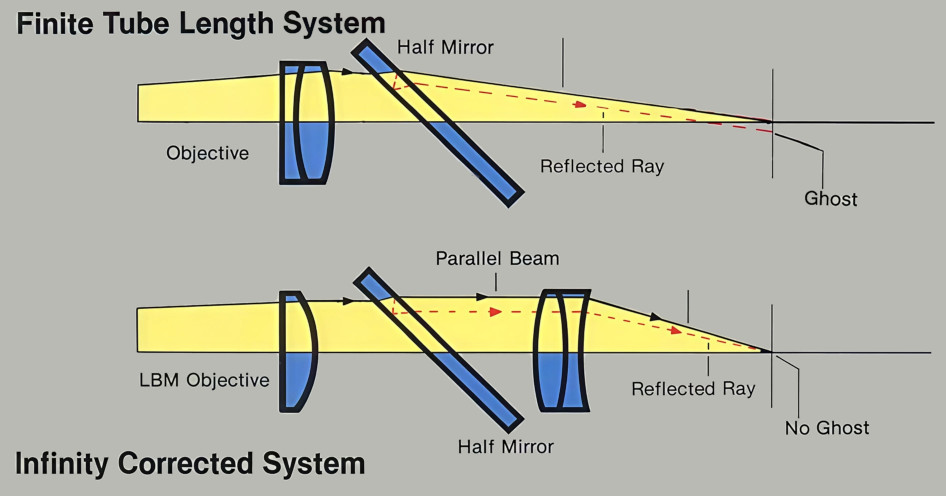
Image credits: Olympus
Because epi-illumination requires additional optical length, manufacturers typically address this by:
- Adding lenses to increase the mechanical tube length (e.g., Amscope ME580T), or
- Designing objectives specifically for a longer tube length (e.g., Nikon 210 mm M Plan objectives)
In short
- Direct image projection is only practical with fully compensated objectives
- Finite optics involve compromises when using epi-illumination
- A large sensor is usually required to achieve a wide field of view
Infinity-corrected optics
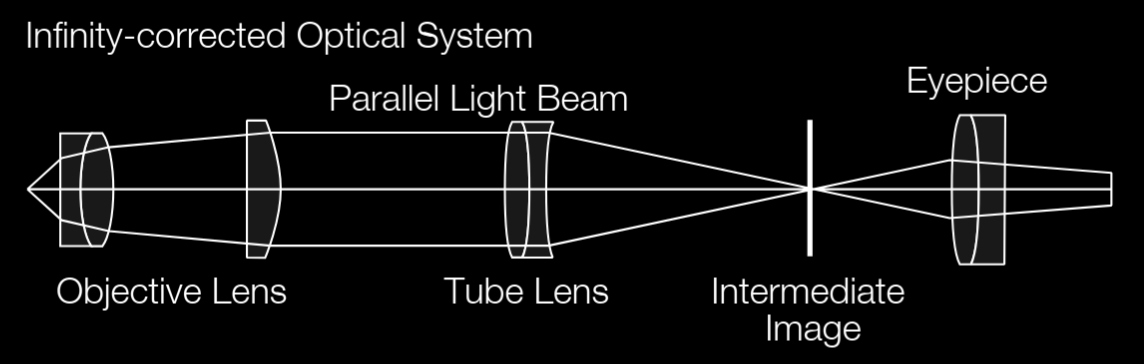
Image credits: Olympus catalog
Tube lens
The main difference with finite optics is that infinity-corrected (IC) objectives projects a collimated beam and requires a tube lens (also called telan lens) to focus and form a real image.
The tube lens is a very important part of an IC microscope system and can be very expensive. Ideally, you want a tube lens that form an image as sharp as possible without introducing any aberrations. For this reason, using an achromat doublet is usually not desirable.
A tube lens with high level of corrections can cost $600 / 500€ new, sometimes even more (like widefield tube lenses).
How to recognize an infinity-corrected objective
Most of the time, markings works exactly like finite objectives, but instead of a finite mechanical tube length the infinity symbol is marked (e.g., ∞/0.17).
Sometimes, the expected tube lens focal length (TLFL) is also marked.
Ex: f=180 on Olympus MSPlan objectives.
Expected TLFL depend on the manufacturer:
- 164mm for Zeiss
- 180mm for Olympus
- 200mm for Nikon and Mitutoyo
Infinity space
The space between the objective and the tube lens is called infinity space.
In this space rays are collimated (but the complete beam is still divergent) so it’s possible to place prisms and filters without inducing aberrations and it will not increase the optical path length.
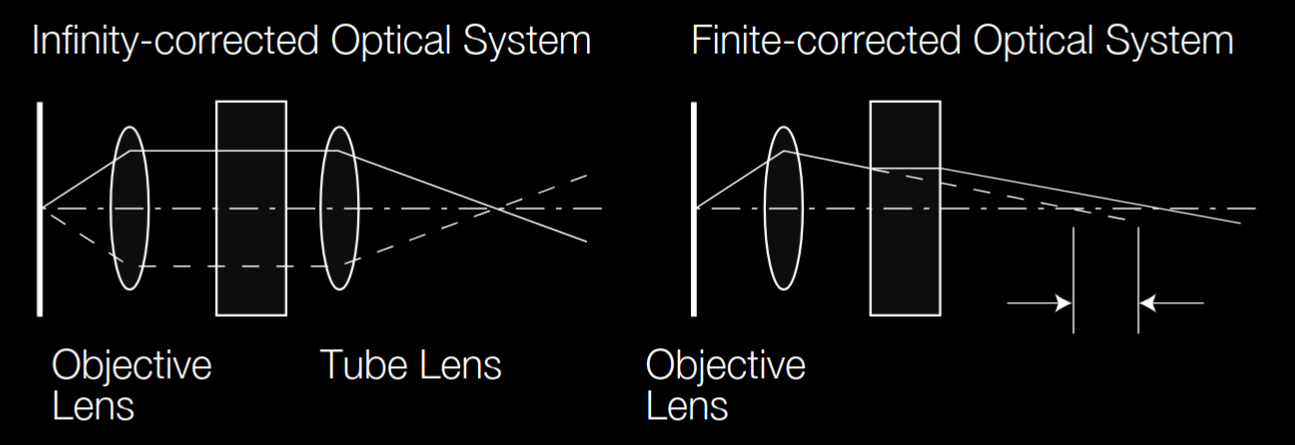
Image credits: Olympus catalog
The infinity space can be extended to fit more options to the microscope.
But some distance is recommended by the manufacturer.
Using a too long infinity space can cause vignetting.
For UIS2 systems, the recommended distance is 50-170mm.
Tube lenses and eyepieces correction
As with finite microscopes, some manufacturers decided to not fully correct the objectives and to place some corrections in the tube lens and/or the eyepieces.
- Zeiss are well known to use a proprietary tube lens with special corrections.
They seems to suffer of some chromatic aberrations when used on other microscopes. - Meiji objectives are almost unusable on fully corrected systems because only a tiny part of the image is flat.
- Modern Olympus (UIS and UIS2), Nikon CFI and Mitutoyo are fully corrected.
- Older Olympus LBM objectives (MSPlan, MDPlan) requires some corrections in the eyepieces to correct for CA.
- Nikon CF Plan EPI objectives seems to have some lateral CA when used with a neutral TL.
Expected tube lens focal length and sensor size
As an IC microscope objective is designed for a specific focal length, the magnification of the system can be changed by using a tube lens with a different focal length.
For example using a Nikon or Mitutoyo (f=200mm) objective with a 100mm tube lens will result in a 0.5x magnification.
This allow to adapt the system to the sensor size of a camera. A longer FL tube lens can be used with bigger sensors, and a shorter one with smaller sensors.
Sadly, there is a limit with short FL tube lenses, as explained in the next section.
Tube lens focal length
The focal length of a tube lens will determine how hard it is to design and manufacture.
The longer the FL, the easier the optical design:
- 400mm FL can be manufactured with only 2 elements
- 200mm FL requires only 3-4 lenses, they are commonly available but expensive
- 100mm FL requires 5-6 lenses and are not really manufactured
Common TL combinations
- Olympus UIS / UIS2:
- U-TR30 trinocular head
- U-TLU single port tube lens. Can be found around $200 second hand.
- U-SWATLU single port widefield tube lens for UIS2 FN26.5mm objectives.
- Mitutoyo M Plan Apo:
- TTL200
- ITL200
- Mitutoyo M Plan Apo 5x/0.14:
- DCR-150 for macro photography
- Kenko No. 5 for macro photography
- Nikon CFI:
- ITL200
Cheap tube lenses
For larger sensors the DCR-150 and Kenko No. 5 can be found for cheap (less than $50) and yield good results.
For Olympus UIS/UIS2 objectives it is possible to extract the tube lens from a U-BI30 binocular head with broken binoculars.
They sometimes can be found around $50.For smaller sensors (2/3“) the DCR-250 can be used.
In combination with 1” sensors it is possible to achieve a wide field of view.For 1/2" sensors a 100mm doublet will give much better results than any tube lens in combination of a 0.5x relay lens like the 0.5x eyepieces adapters supplied with toupcam cameras.
In short
- Infinity-corrected systems are usually more expensive, but have much more flexibility.
- Olympus UIS/UIS2, Nikon CFI and Mitutoyo objectives are fully corrected and can be used in other systems.
- Cheap combinations of sensors / tube lenses are possible.
- No ghost image with epi illumination or filters placed in the infinity space.
- Optical path length can be extended in the infinity space.